
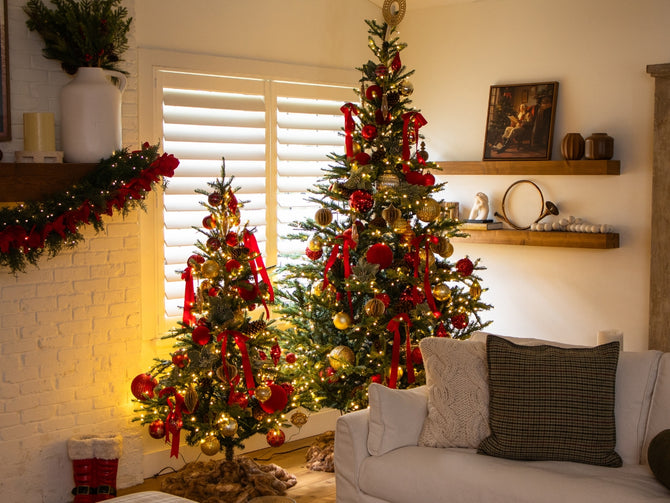

Before making a Christmas tree taller, decide whether the missing height is visual or physical. A proportionate topper, a clearer view of the lower branches, and vertical decoration can improve the silhouette. A raised support changes the setup itself and is only an option when it is compatible with the tree, stand, and support manufacturers' requirements.
This guide helps you compare styling, an approved support, and how to choose a taller tree. Measure the finished display first so you can make that decision before buying a riser, topper, or replacement tree.
Compare the Three Ways to Solve the Height Problem
If your Christmas tree looks shorter than you'd like, you have a few options. You can use decorating tricks to create the illusion of height, raise the tree with an appropriate support if the manufacturer permits it, or choose a taller tree. The table below can help you decide which approach makes the most sense for your space.
|
Your situation |
A useful next step |
What to compare before spending |
|---|---|---|
|
The tree fits, but looks visually short |
Reveal its outline and try a proportionate topper |
Actual added topper height and branch support |
|
You want a physical increase under the tree |
Check whether a compatible rated support is permitted |
Manufacturer approval, base dimensions, load, and stability requirements |
|
You want a substantially taller display |
Compare a taller tree with a suitable base |
Assembled height, width, lighting, and storage needs |
Before deciding how to make your Christmas tree taller, consider the cost, effort, and results of each option. Sometimes a few simple decorating changes are all you need, while other situations may call for a more substantial solution.
If you would like a new tree, shop artificial Christmas trees, reviewing both height and diameter. If height is available but floor space is not, compare slim Christmas trees. A narrow silhouette may give you the vertical presence you want without using the footprint of a broad tree.
Measure the Tree and the Space Above It
Measure the assembled tree on its intended stand. Product listings may state height differently, so confirm whether the stand is included rather than counting it twice. Record the highest point with the branches shaped as directed.
Then measure from the floor to the ceiling or the lowest fixture above the display. Look for a fan, light fitting, beam, or sloped ceiling that reduces the available space. The lowest relevant point, not the tallest part of the room, determines what fits.
A practical way to plan the total is:
Finished height = assembled tree height + approved support height + the topper's extension above the tree.
The topper's full length may not be the amount it adds. Part of a topper can sit over or within the top branch. Measure the actual extension once you know how it attaches, and leave the clearance required by the tree, topper, fixtures, and surrounding equipment.
For illustration, a 72-inch assembled tree, a compatible 6-inch support, and a topper extending 8 inches above the tree would reach 86 inches. That calculation describes height only. It does not establish that the support or the finished arrangement is suitable.

How to Safely Raise a Christmas Tree Off the Floor
If you want to make your Christmas tree taller by raising it off the floor, start by considering the tree's size, weight, and overall stability. Adding height beneath the stand raises the tree's center of gravity, which can make it easier to tip over if the base isn't properly supported.
Choose a sturdy, level platform that's large enough to accommodate the entire tree stand. Consider the weight of the tree, ornaments, and lights, as well as how securely the stand will remain in place. A platform that can hold the weight isn't necessarily stable enough for a tall, decorated tree.
Measure the tree stand's full footprint, including all its legs, before choosing a platform. Make sure the stand fits completely on the surface without any overhang, and position the raised tree where it won't obstruct walkways or be easily bumped.
Avoid improvised stacks of boxes, loose blocks, or furniture not designed for the setup. A decorative crate, basket, or tree collar should not be assumed to be structural support because it looks substantial in a photo.
Set Up the Support Before Decorating the Tree
Follow the support and tree instructions in the final display location. Use the required level surface and any specified attachment or retaining components.
Assemble the tree in the prescribed order. Check that sections and stand connections are fully seated and secured, and that the support remains correctly positioned. If you notice rocking, shifting, leaning, or an incompatible fit, stop and resolve it before adding decorations.
Keep electrical cords accessible and free from pinching at the base. Do not stretch a cord to reach an outlet after raising the tree. Plan its route so it does not cross a walking path or get trapped beneath a support point.
Recheck the setup as decorations are added, particularly when placing a topper or heavier ornaments. Do not use a skirt or collar to conceal a problem with the stand. Covering the base should be the finishing step after the complete arrangement fits correctly.
Hide the Base Without Hiding What You Need to Reach
A tree skirt can soften the transition between a raised support and the floor. Choose enough fabric to cover the visible area without pulling it tight or leaving excess material where people walk.
A decorative collar can also finish the base if its opening accommodates the complete assembly. Check both its height and inside width. It should fit around the support rather than forcing the stand into a smaller space or carrying the tree's weight.
Leave access to the power connection and any controls that need to remain reachable. Take care that electrical components are safely away from material. Position wrapped gifts only after you can see that the stand and support remain correctly arranged.
If the raised base looks disproportionately tall compared with the branches, the tree may be too short for the effect you want. Concealing more of the base will not always fix that proportion.
Add a Topper That Extends the Silhouette
A slender topper can make the tree's outline feel more complete. Options include a narrow star, an upright bow, or a small arrangement of decorative stems, provided the upper branch and attachment system can support them.
Hold the topper near its intended position before attaching it. Check the view from across the room and measure the resulting height. A very broad topper can make a short tree look wider, while an overly heavy one may lean or bend the top.
Use the topper's intended attachment method. Do not cut the center pole, add an improvised pole extension, combine unrelated tree sections, or stretch built-in wiring to create more height. Those changes alter the structure or electrical system rather than simply decorating the tree.
Use Ribbon and Ornament Placement to Draw the Eye Up
Vertical ribbon arrangements can emphasize the line from the lower branches to the top. Let the ribbon move in loose, staggered curves, with sections tucked into the tree so it has depth. Avoid making a tight horizontal band around the widest part if your goal is a more vertical appearance.
Repeat a color from the lower branches near the middle and top. This helps the eye travel through the tree instead of stopping at a crowded lower section. Keep decorations near the top proportionate to the branches that support them.
You do not need to remove all larger ornaments. Distribute them thoughtfully and use lighter, smaller pieces where the tree narrows. Our Christmas tree ribbon guide explains how to create vertical cascades without changing the tree itself.
Let the Whole Tree Be Seen
Before buying a support, view the tree from the room's main entrance and seating area. A chair or console may be hiding enough of the lower branches to make the tree seem smaller than it is.
Try moving your Christmas tree to a spot where its full shape is more visible. Giving it some space away from furniture and other decorations can help create the appearance of greater height. Keep the route through the room comfortable and the electrical connection practical. Do not tilt a tree to make it appear taller or place it where its upper branches interfere with a fan or doorway. Always keep away from heat sources.
If sparse branches are part of the problem, improve the shape separately. Our guide to making a Christmas tree look full covers fluffing and decoration placement. Fullness and height are different adjustments, even when a tree needs both.
Compare Two Sizes Using the Finished Display Height
Consider a room with a 96-inch ceiling. A tree listed at 84 inches leaves 12 inches before adding any topper extension or other required clearance. If the topper adds 8 inches above the listed height, only 4 inches remain. This arithmetic illustrates how quickly the extra room disappears. Allow space above the topper so the tree does not feel cramped.
Check whether the listed tree height already includes its stand, and then measure the actual topper extension rather than adding the topper's full length if part of it sits down inside the branches.
Mark a potential tree's widest diameter on the floor with a removable measuring reference. Walk around it and check the view from your main seat. Choose the height that works with the width instead of buying the tallest tree that fits under the ceiling.
Christmas Tree Height FAQs
Can I put my Christmas tree on a table?
Only if the tree is intended for that type of display and the table is suitable for the complete setup. A tabletop tree and a full-size floor tree are different applications. Do not assume a table is appropriate simply because the stand fits on it.
Can a tree collar make a Christmas tree taller?
A decorative collar usually hides the stand rather than raising it. It should not support the tree unless it is explicitly designed and specified for that purpose. Measure the collar around the approved setup, not as a substitute for it.
How much height can I add beneath the tree?
There is no universal safe amount. How much height you can add depends on the size and weight of your tree, the stability of its stand, and the surface beneath it. Make sure the tree remains stable and secure, especially when adding height beneath its base.
What is the easiest way to make a tree look taller?
Reveal more of its outline, choose a proportionate topper, and arrange some decorations vertically. These changes can improve its appearance without adding a raised support. Measure the topper's extension so the finished display still fits the space.
Choose a Setup That Fits Without Complication
If styling gives you the appearance you want, keep the tree and adjust its topper, position, or decoration. Use a raised support only when the complete setup is expressly suitable. If it is not, compare a better-sized tree instead of improvising around the stand.
Shop Nearly Natural's Christmas tree collection with your height and width measurements ready. For a narrow space, start with slim artificial Christmas trees, or explore the full collection for fuller options.


